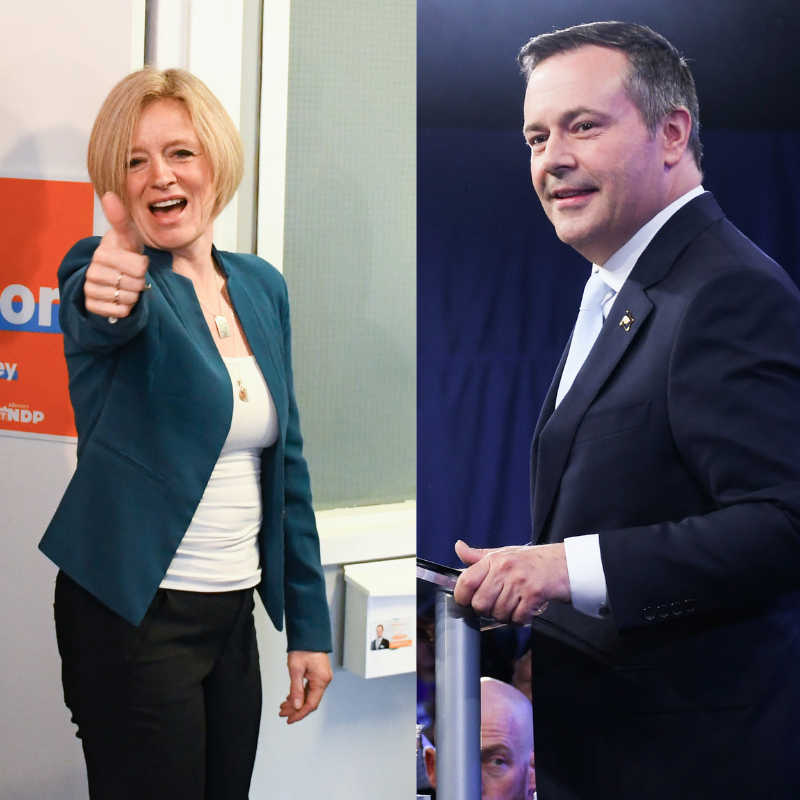
In 2019, social media has played an important role in every major political party’s communication strategy; what a party says and does on social media gives us insight into the strategies they believe will win the election.
According to Geoffrey Hale, a political scientist at the University of Lethbridge, social media has become a tool to get unfiltered and unmediated messaging to groups of voters who will be sympathetic to their message.
For instance, if you look at the two front running parties in this election, you can see that both the UCP and the NDP targeted each other with negative messages, while simultaneously trying to highlight their own strengths to followers.
“The way to look at how parties are preforming is to look at what issues are they emphasizing during the campaign,” said Jared Wesley, a political scientist at the University of Alberta.
For example, Wesley points to the UCP’s strategy of unveiling their education plan early, because they knew it would be controversial, but it would give them an opportunity to move on.
“They got that issue out of the way so that they could try to reframe the election around the issues that voters trust them most on,” said Wesley.
NDP vs. UCP
For the NDP, their social media campaign featured the party’s leadership on social issues, and repeated the message that Jason Kenney is unfit to be premier. Some of the biggest attacks on Kenney surrounded his work as an anti-abortion activist, his stance on GSA’s, and the potential cuts to healthcare if Kenney is elected premier.
The UCP focused heavily on the economic failings of the NDP, and outlined what they would do to help boost the province’s economic prospects if elected. The UCP’s main attack strategy was to paint a picture of NDP’s financial mismanagement and declare the UCP’s willingness to combat perceived conspiratorial threats to the oil and gas industry.
Periphery parties = more policy?
Outside of the two frontrunner parties, who sniped at each other throughout the entire campaign, we saw a more policy-focused conversation from the Alberta Party, the Alberta Liberal Party, and the Alberta Green Party.
The Alberta Party took to Twitter to discuss issues targeted at the pro-business middle class, offering a number of policies that benefit working families. Also, they tried to get attention by positioning themselves as a strong information-based champion of the majority, speaking against pseudo-science conspiracy theory issues like vaccinations and fluoride in drinking water.
The Alberta Liberal Party tweeted about a number of policy issues in Alberta, and tried to occupy the ideological middle between the NDP and the UCP. Their support for GSA’s and new taxation measures, while simultaneously supporting income tax cuts, helped the party achieve this balance.
In this election, the Green Party of Alberta used their Twitter account as a forum to speak about environmental and progressive social policy. The party supported measures like universal basic income and a provincial sales tax. They also advocated for a more robust province-wide approach to environmental issues.
A breeding ground for divisiveness?
Recently, people have begun to blame social media for the efficient transmission of divisive and disparaging political messages.
Is social media responsible, at least in part, for the polarization of Alberta politics?
According to experts, it’s difficult to specifically blame all of the perceived negativity and divisiveness on social media.
Campaigns have always functioned around the idea that parties are trying to motivate their supporters, and according to Wesley, prior to social media this was achieved by direct mail and telephone campaigns.
“Campaigns are all about trying to get your priorities out there, and making sure people are thinking about your issues when they get to the ballot box” said Wesley.
“Both parties are trying to fire up their supporters, while using social media in an effort to target wedge issues, in the hope of depressing turnout by soft supporters of the other camp,” said Hale.
What does it all mean?
So, while it seems that social media campaigns are designed for decided voters, how does this affect voters who don’t specifically support a single party?
At times throughout this election, it seemed like access to more information didn’t necessarily translate into a better understanding of the issues. Social media messaging seemed to rely heavily on messages created from snippets of information shoehorned into whatever narrative each party was trying to project, often with confusing results.
“I think we have to get by the romantic notion that elections are about a bunch of voters who haven’t made up their minds, and that parties are trying to engage them in some kind of great debate over public policy,” said Wesley.
“Campaigns are still a matter of parties trying to get their supporters to the polls.”
Follow me on Twitter @thebeluganews
Featured image: Mark Wiseman